COMMENTARY BY THOMAS FORSYTH & GUEST
Guest authors are invited to submit articles for posting
"MAGIE INVENTS MONOPOLY AND LANDLORDS"
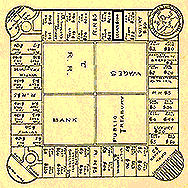
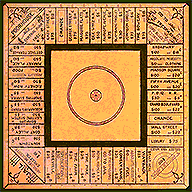
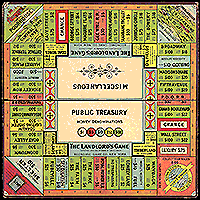
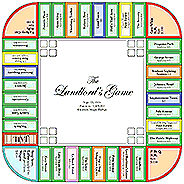
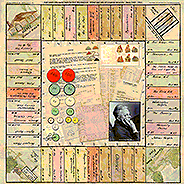
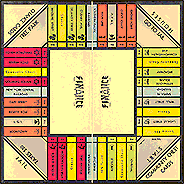
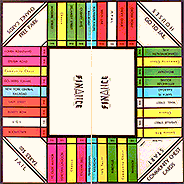
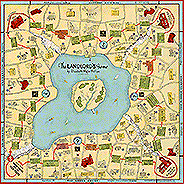
Thomas Forsyth: Magie's summer 1903 version Landlord's Game as played in Arden, DE, lends insight into her invention of the game monopoly.
I know from hearing from you that this site is due for some updates and I agree. I am working on updates and as I can make time I will do so. Feel free to make recommendations (including telling me about typos and broken links) or submit items to contribute.
- You can contact Thomas Forsyth, the website's historian at: -
READING RECOMMENDATIONS
in no particular order
The Monopolists: Obsession, Fury, and the Scandal Behind the World's Favorite Board Game - by Mary Pilon --- FEB 2015
- (The following book description is a reprint from Amazon.com website - link to via book name) With its origins rooted in one of the Wall Street Journal’s most emailed stories, The Monopolists is the inside story of how the game of Monopoly came into existence, the heavy embellishment of its provenance by Parker Brothers and multiple media outlets, the lost female originator of the game, and one man’s lifelong obsession to tell the true story about the game’s questionable origins. Most Americans who play Monopoly think it was invented by an unemployed Pennsylvania man who sold his game to Parker Brothers in 1935 and lived happily ever after on royalties. That story, however, is not exactly true. Ralph Anspach, an economist and refugee of Hitler’s Danzig, unearthed the real story and it traces back to Abraham Lincoln, the Quakers, and to a forgotten feminist named Lizzie Magie. The Monopolists is in part Anspach’s David-versus-Goliath tale of his 1970s battle against Parker Brothers, one of the most beloved companies of all time. Anspach was a professor fighting to sell his Anti-Monopoly board game, which hailed those who busted up trusts and monopolies instead of those who took control of all the properties. While he and his lawyers researched previous Parker Brothers lawsuits, he accidentally discovered the true history of the game, which began with Magie’s Landlord’s Game. That game was invented more than thirty years before Parker Brothers sold their version of Monopoly and she waged her own war with Parker Brothers to be credited as the real originator of the game. Ironically, the Landlord’s Game, like Anti-Monopoly, was underpinned by morals that were the exact opposite of what Monopoly represents today. It isn't surprising that Magie's game was embraced by a constellation of left-wingers from the Progressive Era through the Great Depression, including members of Franklin Roosevelt’s famed Brain Trust. More than just a book about board games, The Monopolists illuminates the cutthroat nature of American business over the last century--a social history of American corporate greed that reads like the best detective fiction, told through the real-life winners and losers in the Monopoly wars.
Articles by Mary Pilon*
Monopoly’s Inventor: The Progressive Who Didn’t Pass ‘Go’ - by Mary Pilon
THE NEW YORK TIMES - Business - online: February 13, 2015 (Sunday Paper Feb 15, 2015)
- Article discusses some of the origins of monopoly before the Parker Brothers version. It has some insights into the book ' The Monopolist' by Mary Pilon due out the week following this article.
Monopoly Goes Corporate - by Mary Pilon
THE NEW YORK TIMES - The Sunday Review - Opinion Section - August 24, 2013
- This article published in the New York Times by investigative journalist Mary Pilon discuses Hasbro's introduction of Monopoly®, 'The Corporate Version' and how it finds itself in contrast from the game's origins with inventor Lizzie Magie Phillips.
How a Fight Over a Board Game Monopolized an Economist's Life - by Mary Pilon
THE WALL STREET JOURNAL - Page A1, October 20, 2009
- This front page article published in the Wall Street Journal by investigative journalist Mary Pilon discuses both the past and present battles of Dr. Ralph Anspach in his decades long battle to not only get the true story of monopoly told, but to market his game "Anti-Monopoly®" against market barriers set up by Goliath competitors.
Can’t Play by the Rules? It’s Fine by Mr. Monopoly - by Mary Pilon
THE NEW YORK TIMES - Business Day - March 25, 2014
- This article discusses Hasbro opening up the rules to change. Ah, but what about all those rules lost before Parker Brothers acquired the game? But then who wants to dig up the past...
* Mary Pilon is an award-winning staff reporter at The New York Times where she currently covers sports. She previously worked at The Wall Street Journal, where she wrote about various aspects of economics and the financial crisis. She has worked at Gawker, USA Today, and New York Magazine and is an honors graduate of New York University. Her work has garnered awards from the Freedom Forum, the Society of American Business Editors and Writers and she was part of the Journal’s team that won Gerald Loeb and New York Press Club Awards in 2011 for covering the “Flash Crash” of 2010. She made the Forbes magazine's first-ever 30 Under 30 list for media. A native Oregonian, she currently lives in New York City. Visit her web site at marypilon.com and find her on Twitter @marypilon.
My personal note... Mary makes no claim to an 'exclusive' on a book about the game history contrary to what some might have said about this in recent forums. This should be obvious to most as a number of books already exist. I feel each person brings their own point of view and hopefully new insights if they've done their homework. I agree with Mary that anyone willing to put in the time and effort has the same right to publish in book form. I'd add that the ability to publish successfully very much depends on one's ability to develop workable contacts and relationships with others, their experience in the field, and their journalistic talent.
More about Mary....
Do Not Pass Go: The Real Story Behind Monopoly: Publisher's Weekly Talks with Mary Pilon - by By Kyle Tonniges
PUBLISHER'S WEEKLY - Jan 09, 2015
- This article is a discussion with Mary about how her new book came about.
---
The Landlord's Game - by Lizze J. Magie
THE SINGLE TAX REVIEW - Autumn 1902
- The first known mention of The Landlord's Game is in this article authored by Lizzie Magie four to six months prior to her first game patent application made in March of 1903 and granted January 1904.
Monopoly Is Theft - by Christopher Ketcham
HARPER'S MAGAZINE, THE STREAM - Special Features — October 19, 2012
- Launching Harper's online magazine 'The Stream' in 2012, this seven page article is well titled. Christopher Ketcham spent a great deal of time researching before writing the article. He found like many others delving into the topic that there is so much to discover and discuss and grappled with how to edit it down to the size it is. Overall the article gives a good overview of the game's sorted history. Chris also includes a readable explanation of the game's Georgist roots for those of us without a background in, or firm grasp of, economics!
From Berks to Boardwalk - by Charles J. Adams III
HISTORICAL REVIEW OF BERKS COUNTY - Volume XLIV, Number 1 Winter, 1978-1979
- This article written in the 1970's in one of the best as it was done with personal interviews with the players in Reading, PA, from the 1920s era of monopoly. There are a number of references sited at the article end which is useful in research.
Early Monopoly - Elyse Luray, Commentator
THE HISTORY DETECTIVES, PBS - Season 2, Episode 2, 2004 - Show Transcript
- I worked extensively with PBS through Oregon Public Broadcasting on this episode. Elyse has commented it is one of her favorites. The director did a fantastic job as did the crew. The big break through came in getting Ron Jerrel to discuss his Arden board. When I did my part of the interview I had not slept in thirty some hours. Needless to say it took a few takes to get what they wanted (I still chuckle about that.)
What happened behind the scenes of this episode of "History Detectives" may have been as interesting as the story itself. It was ironic that we were working from the same PBS station where Ralph Anspach's book begins his own journey into the history that would be the foundation for telling this story. When I watched the show air I was surprised at some of the final edits. Missing was some discussion I believe both the director and me thought very relevant to telling the story. Content that got left out, in my opinion that might lead to some wrong conclusions about the history itself, something I feel strongly about. Okay, that happens, but I was really taken aback when the credits rolled and one name was clearly missing, Ralph Anspach's! The story never would have been told without his research as a background to build the story upon. Was this simply an error? My understanding is that the director did include Ralph's name in his edit, but the final cut came after it went back East to PBS headquarters for approval. So why the post edit and removal of his name?
PBS depends on corporate sponsors, but do they have some influence in content that gets aired so as to be in their best interest? Did PBS corporate make final content edits of this episode to appease interest of a PBS sponsor? These are questions not statements. I love PBS, I love BIG BIRD too, I support PBS and I encourage you to become a member of your local PBS station. I'm just commenting from an insider’s point of view having watched the development of this story and knowing what the final edit left out. I've been around TV production my whole life having directed my first show for cable in 1975. So I am not unfamiliar with editing and how a lot ends up getting cut with absolutely no malice or conspiracy. One has to tell an interesting story in a specific amount of time. That means choices must be made about content. But for me, this particular "WHY" of this particular content will remain an interesting mystery. Not to leave on a negative... this really was a big break through when the crew got to Arden and I felt the focus on that story line was well deserved and very important to the history.
Letter by Eugene Raiford, 1964.
FROM THE ANSPACH / RAIFORD ARCHIVES
- This article written by the 'Colonel' as he was referred to by those who knew him, writes a letter in response to the incorrect history that Charles Darrow invented monopoly. He recounts how the Todd's had learned monopoly from him and Darrow from the Todds. That Darrow never wrote his own rule set, rather, it was Charles Todd's wife who had made a set of carbon copy rule sets for both him and Darrow. These carbon copies still exist in two sets - the Darrow round game and his first square set. When the Todd's copied the Raiford game they made a typo on the spelling of Marven Gardens (combined from MARgate City and VENtor City. The plagiarism of Darrow was such that the misspelling, spelled with an “i” not an “e”, still exists on Parker Brothers version Monopoly® sets to this day.)
Sotheby's recently auctioned both the Darrow boards and the Todd game. Just prior to auction bidding they made a statement that implied the Todd game may date to 1937, based on a Todd deposition. They failed to mention that later in court testimony by Todd, accepted by the court as truthful evidence, that Todd did teach monopoly to Darrow, and that clearly placed the Todd game prior to any of Darrow's in 1933. It is still unclear where Sotheby's got their information since Ralph Anspach, who was quoted in the Sotheby's pre-bid announcement, was never contacted for accurate and/or verifying information. They even stated Ralph's Book was unpublished, even though quoted from it?! I hope to post more about this occurrence on the web site, including the testimony that was accepted evidence that Darrow did learn monopoly from the Todds, and did copy the rules of monopoly, having never written them at all, rather plagiarized when he claimed copyright to them. The purchased Todd game has not been in public shared since the auction. Do you know where it has gone? If so, I'd love to hear from you.
The Anspach Archives - Collection Listing
THE ANSPACH/ RAIFORD ARCHIVES
- These are the documents collected over many years by Ralph Anspach. They were sold a number of years ago and now reside in a private collection of a family member closely related to the Atlantic City era of the game history (Raiford) and are being archived and preserved for future historical reference. If you have a question about the archives you may direct a question to Thomas Forsyth at:
BOOK RECOMMENDATIONS
The Monopolists: Obsession, Fury, and the Scandal Behind the World's Favorite Board Game - FEB 2015
- by Mary Pilon, More than just a book about board games, The Monopolists illuminates the cutthroat nature of American business over the last century--a social history of American corporate greed that reads like the best detective fiction, told through the real-life winners and losers in the Monopoly® wars. The book weaves through the lives of Lizzie Magie Phillips, the Atlantic City Quakers, Charles Darrow, George Parker and his step son Richard Barton, Ralph Anspach, and others in a personal way delving into the their motivations, pain, and victories with the insightful journalist edge Mary Pilon brings to all of her work.
You can read other articles about game history by Mary in the New York Times and Wall Street Journal (see links above).
MONOPOLYGATE - The True Story behind the game of Monopoly®. (Earlier editions named 'The Billion Dollar Monopoly Swindle')
Truth seeker Ralph Anspach brings us a must read book that challenges other accounts of the history; indeed Ralph wrote much of the history during his decade plus court battles. Supported by facts, this story brings us all the way to the U.S. Supreme Court and back to Lizzie Magie. ---- The book by Ralph Anspach is now out on Kindle in electronic form. Earlier hard copy printings may be found on MONOPOLYGATE
THE PLAYMAKERS - A beautiful coffee table book by Tim Walsh. It has a great chapter on the history of the Landlord's Game and Monopoly®.
Spanning a century of toys and games this is a great coffee table book for all ages.
MONOPOLY - The world's most famous game & how it got that way
- by Phil Orbanes, author of previous monopoly books, Phil writes his most extensive game history to date covering from 1903 to 1972. It gives a view point from a former Parker Brothers employee with access to many historical artifacts and personal relationships.
To balance the historical interpretation presented in Phil's book, I would recommend one read the book "The Monopoly Detective" (previously "Monopolygate") by Ralph Anspach. It is this writers opinion that one can not get an accurate take on the true and complete history of the games Landlords or monopoly without reading the facts in their entire context as laid out by the man who uncovered them...
RECOMMENDED WEB LINKS
HISTORY DETECTIVES - 'History Detectives' brings to light newly discovered history on the origins of Monopoly®. This site's author helped PBS put together the PBS program, program includes interview with this site's author, Thomas Forsyth, and others. The episode turned out to be one of the most popular pieces done by the program. See my commentary above under 'Suggested Reading'. For additional info see pbs.org"
ANTIMONOPOLY.COM
You can buy the Anti-Monopoly® board game, read about Ralph Anspach's book, his court battles, and additional history.
The updated site has web links for electronic games, additional game history, and includes “Live Help.”
THANKS & CONTRIBUTIONS
This site is not possible without the generous contributions of many people who have shown me their trust, shared both their knowledge and their research. A few names I'd like to mention; Ralph Anspach, Richard Biddle, Chris Williamson, Phil Orbanse, Becky Hoskins, Albert Veldhuis (rip), Ronald Jarrell, Tim Walsh, David Sadowski, Dan Glimne, Kristian Berg, Malcolm Holcombe, Geo. M. Meiser, Charles J. Adams III; the Magie, Sherk, Thun, and Nearing families, my loving parents, my sister Ann, my good friends, and any others I haven't yet named but I am very grateful for their insight, contributions, and endless assistance.
If you have something to contribute, let me know. This is a site to share.
You can help promote yourself through contributions to this site with credit to you.
Let's discuss how we can help each other tell the true game history.
Sharing Content, Site Policies
Copyrights and Trademarks
2021
© 2021 landlordsgame.info
|
|